The Cost of Not Being Able to Walk Away

I recently had a brief exchange with Antirez about the use of AI in software development. It started from this statement DHH, the creator of Ruby on Rails, posted on X:1
Writing code by hand is no longer an economically viable skill for most programmers at most companies.2
My view is that, when we judge whether AI is economically worthwhile, we also need to account for the dependencies it introduces. Antirez replied that token costs will never make writing code by hand more economical again: open-weight models and the other forces at play will make sure that never happens.
I obviously don’t have a crystal ball, but the problem I see can exist even if Antirez turns out to be right: AI could keep being economically worthwhile for me while becoming increasingly expensive to do without.
OpenAI Pro at $200: same price, less usage
The timing is almost too perfect: OpenAI recently announced a reduction in the usage included with its ChatGPT Pro plan, while keeping the subscription price unchanged at $200 per month.3
OpenAI explains the cut by pointing to greater model efficiency.3
That’s all very nice and interesting, but improving the models and reducing the included usage are two different things.
Taking the seller’s explanation as proof that I haven’t lost anything is like asking the wine merchant whether his wine is any good.
Besides checking whether the new limit actually covers both my normal workload and the extra demand that comes with particularly busy weeks, the underlying issue remains:
after this “update,” I can no longer do everything I could have done before.
The point is that the terms of a subscription can get worse even while the technology gets better.
“It’s still worth it” doesn’t settle the question
Suppose AI lets me work faster. I take on one more project, agree on a price, promise a delivery date. Then the AI provider changes its terms, and maintaining that same pace now costs me more. My commitments haven’t changed, but I have to absorb the additional cost.
Croak..
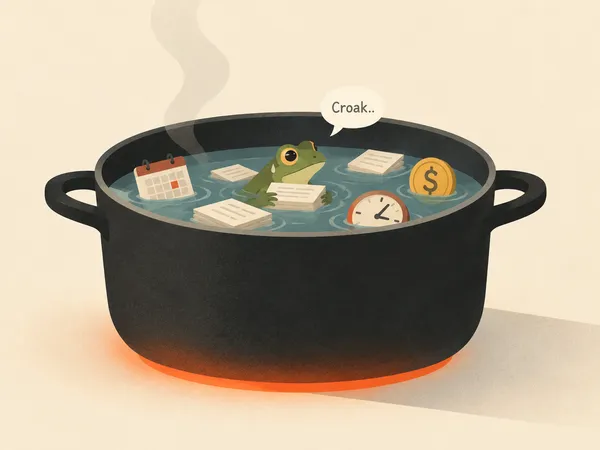
As long as I can move to a viable alternative, I have room to react. But if the capabilities I need are available from only a few AI providers, and replacing them is too expensive, I may accept worse terms because reorganising my business could cost me even more.
The service is still worth using, but a larger share of the advantage it gives me ends up in the seller’s pocket, exploiting a balance of power in which I, the customer, have become the weaker side.
Croak?
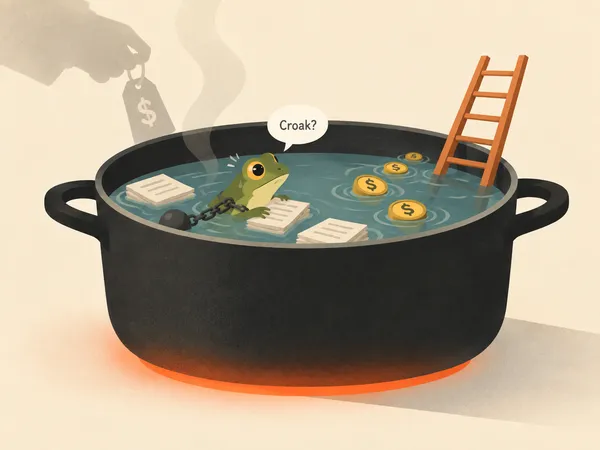
The road to getting myself trapped can be paved with perfectly reasonable decisions: how convenient it feels not to change anything, and how much I need to stay competitive.
Each decision may make sense on its own. But put them together and a path starts to emerge where, at some point, my professional freedom has been eroded.
Croak!
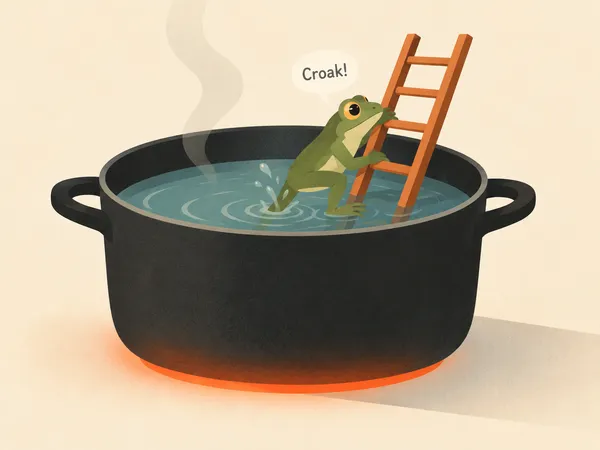
The metaphor is the frog in slowly heating water. But in this version, the frog can notice what’s happening and choose the ladder before getting out becomes impossible.
I own the code, but can I still work on it?
I don’t care who wrote the code. But I do want to understand how the system works, recognise problems, and know how to intervene, including with other tools. If I can no longer find my way around without the AI assistant, having the source code on disk isn’t enough to reassure me.
It’s entirely possible to stay in control of the system while continuing to use AI. It depends on how we use it.
If I delegate every change and every investigation into the codebase to AI without understanding anything myself, owning the files isn’t enough to make me autonomous.
There’s another possibility too: I may keep all my skills, but as AI accelerates my work I may end up producing more software than my company could manage without it. In that case, simply going back to writing and reading code by hand wouldn’t be enough: I would need to be able to continue with another tool.
Open-weight models are a concrete option: models whose weights can be downloaded and run outside the producer’s own service. Antirez himself describes using a local model for work he would previously have given to Claude or GPT.4
If staying competitive has already led me to organise my work around frontier models offered by AI providers, I need to verify that open-weight models are a viable alternative before I can consider them a “way out.”
The money I save on tokens by using those models means little if I spend all of it fixing their mistakes, or if I can no longer meet my deadlines. Hardware, operations, and people’s time all belong in the calculation.
And within the commercial AI market, I would also be perfectly happy with a scenario where the available options are not concentrated in the hands of a few big players.
I’m looking for practical, sustainable alternatives, not necessarily complete self-sufficiency.
I want something to remain even without the assistant
This is the idea I want to explore within ABC through Human-Scale Systems: using AI in a way that leaves software easier to understand for the people who will have to maintain it.
Simpler code, tests that clarify expected behaviour, and decisions explained in project documentation remain useful even when I switch tools.
If, instead, I have to go back to the same chat to reconstruct why a decision was made, then an essential part of the work has remained outside the project.
Maintaining skills, documenting decisions, and testing alternatives takes time. I’m willing to discuss that cost, but I’m not willing to dismiss it as waste simply because the service is convenient today.
Before I build a business around it, I want to be able to answer one question:
If the terms became unacceptable tomorrow, how much time and money would I need to keep working another way?
If the answer is “I wouldn’t even know where to start,” then there’s already a problem, even with the subscription paid and no price increase in sight.
I’m not waiting to get burned before I start looking for the ladder.
Sources accessed on October 1, 2026. Prices are shown in US dollars.
Footnotes
-
David Heinemeier Hansson, personal website, the creator of Ruby on Rails. ↩
-
DHH, original post on X, September 23, 2026. ↩
-
OpenAI, About ChatGPT Pro tiers. ↩ ↩2
-
antirez, A few words on DS4. A personal account of using a local model for some tasks previously given to Claude or GPT, not evidence of universal substitutability. Using a model with available weights also depends on its licence and the infrastructure required to run it. ↩